Darts Exchange Betting: How Back-and-Lay Markets Work
 Available in US

Sportsbook vs Exchange: A Different Playing Field
The first time I placed a lay bet on a darts match, I felt like I’d walked through a door that had always been there but nobody had pointed out. For years I’d been using traditional sportsbooks — picking winners, accepting the price offered, and moving on. The exchange model flipped the entire logic. Instead of betting against the house, I was betting against other punters, and instead of only backing players to win, I could now bet on them to lose. That second option changed how I think about every darts match.
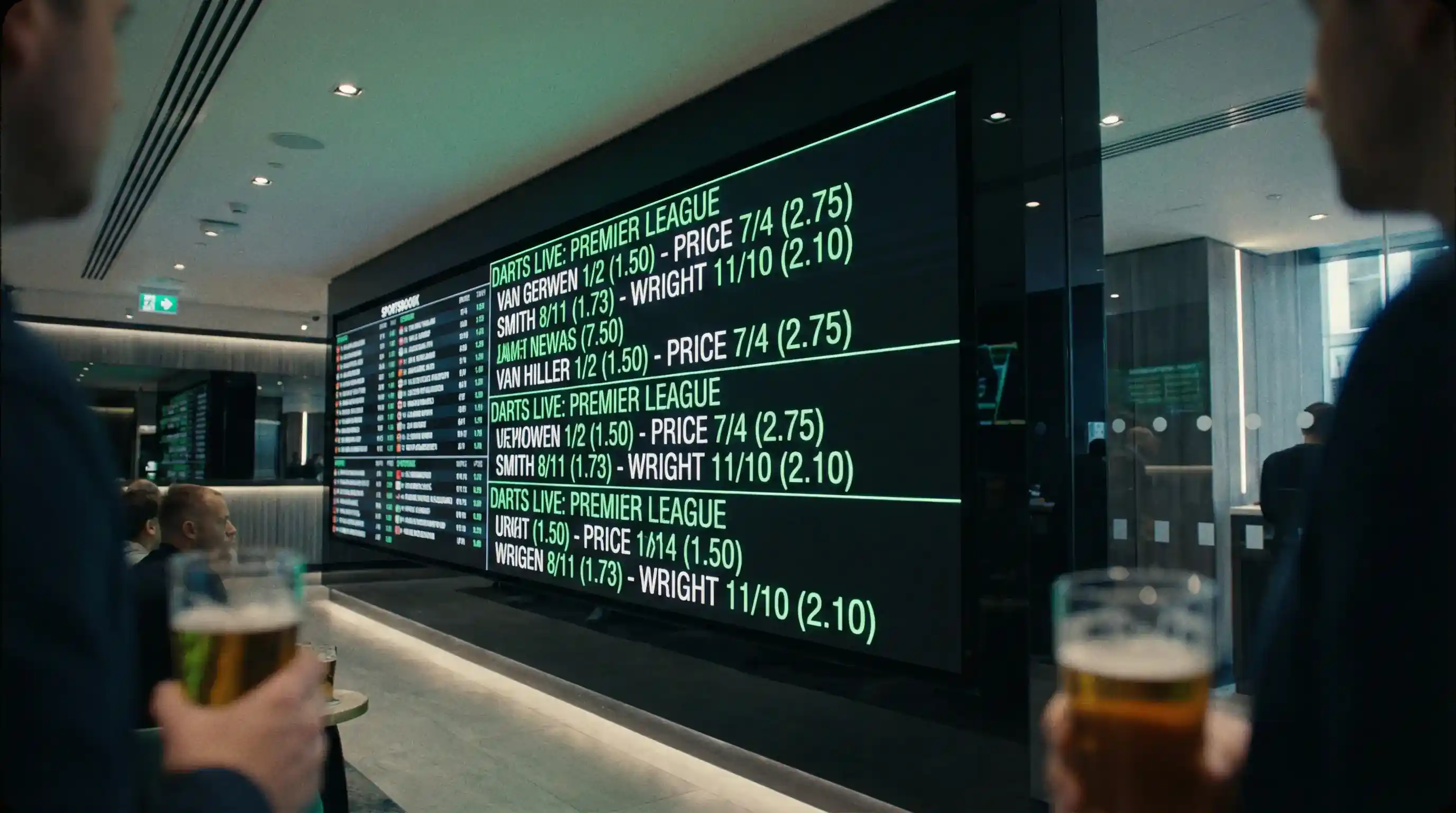
Exchanges operate as peer-to-peer markets. There’s no bookmaker setting the odds — the prices are determined by what other users are willing to offer. If you think a player will win, you “back” them. If you think they’ll lose, you “lay” them. Every back bet is matched by a corresponding lay bet from another user, and the exchange takes a small commission on winning bets, typically between 2% and 5%. Darts betting volume at Entain increased 37% since 2018, and that surge of activity has deepened exchange liquidity for darts, making it viable to trade matches that would have been too thinly covered five years ago.
The fundamental advantage of exchanges is the margin structure. A traditional sportsbook builds a 5-8% overround into darts match odds, meaning the combined implied probabilities of all outcomes exceed 100%. On an exchange, the effective margin is just the commission rate, typically 2-5% depending on the platform. Over hundreds of bets, that margin difference compounds into a meaningful edge for exchange users.
Back and Lay Explained for Darts Bettors
Backing on an exchange works identically to betting at a sportsbook — you stake money on a player to win at a given price. The only difference is that the price was set by another user rather than by a bookmaker’s model. If the back price for a player is 2.50 on the exchange and 2.30 at a sportsbook, you’re getting better value on the exchange for the same opinion.
Laying is the mirror image, and it’s where the real strategic flexibility emerges. When you lay a player, you’re betting they won’t win. Your potential profit is the layer’s stake — if the player loses, you collect what the backer risked. Your liability is the backer’s potential payout minus their stake. So if you lay a player at 3.00 for ten euros, your liability is twenty euros — that’s how much you’d lose if the player wins. But if they lose, you pocket the backer’s ten euro stake minus commission.
Why does laying matter for darts? Because the sport produces a unique situation: heavily favoured players priced at 1.10-1.25 on traditional sportsbooks are almost unbettable on the back side — the return doesn’t justify the risk. But laying the underdog at 5.00-9.00 in the same match can offer attractive risk/reward ratios, especially when you’ve identified a mismatch the market has slightly underpriced. A lay bet on the underdog at 7.00 with ten euros risked gives you sixty euros of liability against the ten euro profit if the underdog loses — but in matches where the favourite wins 85%+ of the time, that equation works out positively over volume.
In-Play Trading on Darts Exchanges
If back and lay are the nouns of exchange betting, in-play trading is the verb. Trading means backing at one price and laying at a different price during the same match, locking in a profit regardless of the final outcome. Darts is exceptionally well suited to this because odds fluctuate significantly between legs, and the data stream is clear enough to anticipate those fluctuations.
A basic trade looks like this. You back a player pre-match at 2.50. They win the first two legs, and their in-play price drops to 1.60. You lay them at 1.60 for a stake that guarantees profit on both outcomes. If they go on to win, you profit from the back bet minus the lay cost. If they lose from that position, you profit from the lay bet minus the back cost. The skill is timing the lay — getting the spread wide enough between your back and lay prices that the guaranteed profit justifies the initial risk.
Ireland’s gambling market, projected at 2.57 billion euros in 2025 with sports betting comprising roughly 15% of that total, generates enough activity that darts exchange markets carry usable liquidity during major PDC events. The World Championship, Premier League, and World Matchplay all produce exchange volumes that support trading strategies. Smaller events and floor tournaments have thinner books, and I’d advise against trying to trade those unless you’re comfortable with wider spreads and slower matching.
The in-play trading edge in darts comes from the discrete nature of each leg. After every leg, there’s a brief pause where the exchange reprices. If you’re watching the match and you notice something the market hasn’t caught — a player’s body language deteriorating, a checkout rhythm breaking down, a three-dart average quietly dropping — you can position yourself before the next leg’s result confirms what you’ve already observed. The delay between observation and market adjustment is small, sometimes just 15-30 seconds, but it’s consistently exploitable for bettors who are watching live rather than relying on scoreboards.
Lower Margins: Why Exchange Odds Often Beat Bookmakers
I routinely compare odds between sportsbooks and exchanges before placing any darts bet, and the exchange offers a better price roughly 70% of the time on match winner markets. The gap varies — sometimes it’s negligible, occasionally it’s substantial — but over a season of betting, the cumulative impact of consistently getting 2.55 instead of 2.40 reshapes your entire P&L.
The margin advantage is most pronounced in three scenarios. First, when there’s a strong favourite: sportsbooks compress the underdog price aggressively to protect their margin, while the exchange lets the market find a truer level. Second, in-play markets during live matches: sportsbook in-play odds tend to be wider than exchange odds because the bookmaker builds in extra margin to compensate for their reaction time. Third, in less popular matches: sportsbooks set wider margins on matches they expect lower volume on, but exchange users who follow those matches closely often set sharper prices.
The trade-off is convenience and accessibility. Sportsbooks offer a simpler user experience, don’t require you to understand lay betting, and provide features like cash-out and acca insurance. Exchanges demand more knowledge, more attention, and more active management. For darts betting specifically, I use both: sportsbooks for specific market bets like 180s props and correct score where exchange liquidity is thin, and exchanges for match winner and in-play trading where the margin advantage is tangible.
Stella David, Entain’s CEO, described the transformation darts has undergone: viewership has surged and betting engagement mirrors this. That parallel growth means exchange liquidity for darts keeps deepening year on year, making this the best period in the sport’s history for exchange-based betting strategies.
Can I lay a darts player to lose on a betting exchange?
Yes, that is exactly what laying means. When you lay a player, you are betting they will not win the match. If they lose, you collect the backer’s stake minus commission. If they win, you pay out the backer’s winnings. Laying is the core feature that distinguishes exchanges from traditional sportsbooks.
Are darts exchange markets liquid enough for meaningful bets?
During major PDC events — the World Championship, Premier League, World Matchplay, and other televised tournaments — darts exchange markets carry sufficient liquidity for stakes up to several hundred euros per trade. Smaller floor events and non-televised matches have thinner books, which can make it harder to get matched at your desired price.
Find the best options for darts betting.
Read our detailed review of Darts Head-to-Head Records: How to Use H2H Data in Your Bets.
Published by the Darts Betting team.