PDC Darts Calendar 2026: A Bettor’s Guide to Every Major Tournament
 Available in US

- Why the PDC Calendar Is Your Betting Roadmap
- World Darts Championship: The GBP 5 Million Centrepiece
- Premier League Darts: Weekly Knockout Wagering
- World Matchplay and UK Open: Legs-Only Formats
- World Grand Prix: The Double-Start Wildcard
- European Tour and Pro Tour: Floor-Event Value
- Seasonal Betting Rhythm: When to Bet and When to Wait
- PDC Calendar Betting FAQ
Why the PDC Calendar Is Your Betting Roadmap
When I first started covering darts professionally, the PDC calendar was a modest affair — a handful of televised majors, a few hundred Players Championship events, and a lot of dead time between them. The 2026 season looks nothing like that. Total prize money across PDC tournaments has surged past GBP 25 million — a GBP 7 million increase compared to 2025 — and the calendar now stretches across virtually every week of the year. Matt Porter, the PDC’s CEO, put it plainly: the incredible growth of the sport has elevated darts to levels never seen before, both in playing opportunities and global interest.
For bettors, this expansion is a gift. More tournaments mean more matches, more data, and more chances to find value. But it also means you need a roadmap. Not every event is worth your attention, and not every format suits the same strategy. A World Championship final played over best-of-13 sets demands a completely different analytical approach than a European Tour quarter-final over best-of-11 legs.
This guide maps the major landmarks of the 2026 PDC season from a bettor’s perspective. For each tournament, I cover the format, the prize structure, and the strategic angles that have worked for me over more than a decade of wagering on professional darts. If you are new to the sport, the complete darts betting guide covers the fundamentals. Think of this page as your seasonal planner — the events circled in red on the calendar where preparation genuinely pays off.
World Darts Championship: The GBP 5 Million Centrepiece
There is a moment every December when the first darts hit the board at Alexandra Palace and the entire betting market shifts into a different gear. The PDC World Darts Championship is the sport’s centrepiece, and in 2026, it became the richest darts event ever staged: a GBP 5,000,000 prize fund with GBP 1,000,000 for the winner. That represented a doubling from the GBP 2,500,000 that had remained flat from 2019 through 2025 — six years of plateau followed by an explosive jump that reflected the sport’s broader commercial boom.
The 2026 edition expanded to 128 players, the largest field in World Championship history. That expansion has direct betting implications. More players mean more first-round mismatches, but also more qualifier wildcards who have nothing to lose and everything to gain. I have found that first-round World Championship matches are the most profitable stage of the tournament for underdog handicap bets, precisely because the best-of-5-sets format gives qualifiers enough legs to compete even when outclassed on average.
The sets format is the defining structural feature. Unlike most PDC events, the World Championship uses sets, with each set consisting of best-of-5 legs. The format lengthens as the tournament progresses: best-of-5 sets in the first round, escalating to best-of-13 in the final. That escalation systematically favours higher-ranked players as the tournament deepens, which is why outright favourites are most vulnerable in the early rounds and most reliable from the quarter-finals onward.
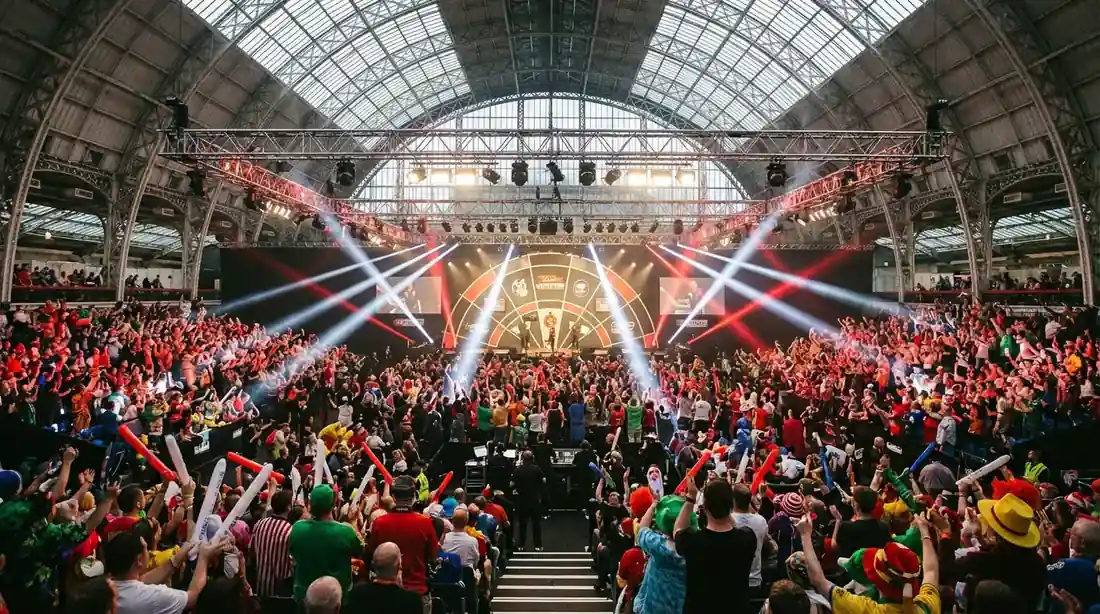
The venue itself will change in the coming years. The PDC has announced a move to the Great Hall at Alexandra Palace, increasing capacity to approximately 5,000 or more spectators from the 3,200 in the West Hall. Matt Porter described Ally Pally as the natural home for darts, and the atmosphere — 170,000 tickets were sold in pre-sale for the 2025-26 edition, with 20% going to international fans — creates a cauldron that affects player performance in ways that are difficult to quantify but impossible to ignore.
One pattern I have tracked consistently across the last six World Championships: players making their Ally Pally debut tend to underperform their season averages in the first round, sometimes by 3-5 points. The noise, the fancy dress, the intensity of a crowd that has been drinking since midday — it rattles first-timers. That debut penalty is not priced into the market because sportsbooks rely on season-long statistics, not venue-specific adjustments. I factor it into my first-round modelling every year, and it has been one of my most reliable edges at the tournament.
From a timing perspective, outright World Championship markets open in late November. I place my initial outright stakes at that point, when the draw has not yet been made and the prices reflect form rather than bracket position. Once the draw drops, I reassess: a favourable draw section can shorten a contender’s price by 15-20%, and occasionally the post-draw adjustment overshoots, creating a window for value on the other side of the bracket.
Premier League Darts: Weekly Knockout Wagering
Thursday night darts has become appointment viewing in the UK and Ireland, and the Premier League is the reason. Eight players, a weekly knockout format, GBP 1.25 million in total prize money with GBP 350,000 for the winner, and a travelling roadshow that visits a different city each week from February to May. For bettors, the Premier League offers something no other PDC event does: a regular, predictable betting rhythm across 17 consecutive weeks.
The weekly knockout format replaced the old round-robin system, and that change has significant strategic implications. Under the knockout format, each night consists of quarter-finals, semi-finals, and a final — meaning three matches per player on a winning night. Fatigue and momentum carry from one match to the next within the same evening, which creates in-play opportunities that do not exist in one-off match formats. A player who scrapes through his quarter-final with a 92 average is unlikely to produce his best in the semi-final 45 minutes later.
Venue matters more in the Premier League than at any other PDC event. Certain arenas produce louder, more partisan crowds, and some players respond to hostile or supportive environments more than others. I track a simple metric: each player’s average and win rate at specific venue types (large arenas vs smaller halls) and cross-reference that against the weekly schedule. The effect is not enormous, but it is consistent enough to be worth incorporating.
The league table introduces a motivation variable as the season progresses. Players locked into the play-offs may experiment or coast in the final regular weeks, while those on the bubble fight for survival. That motivation differential shows up in performance data and occasionally creates odds anomalies — a bubble player priced at 3.50 against a locked-in favourite at 1.50 might be the sharper bet if the favourite has no incentive to peak.
I keep a running log of each player’s average by Premier League night, and the pattern is revealing. Most players show a slight dip in weeks 8-12 — the mid-season grind — before peaking again in the final weeks and play-offs. That mid-season trough creates value on underdogs during the February-March window, particularly when the road-weary favourite is playing in a venue with a historically lukewarm atmosphere. It is a small edge, but the Premier League’s weekly cadence gives you 17 chances to exploit it.
Sky Sports has locked in 60+ days of exclusive PDC coverage annually through 2030, and the Premier League is the crown jewel of that schedule. The media exposure drives public betting volume, which means the odds on Premier League nights are shaped by casual money to a greater degree than at quieter PDC events — a dynamic that the informed bettor can exploit.
World Matchplay and UK Open: Legs-Only Formats
Ask most darts purists which event produces the best quality and they will say the World Matchplay. Held every July in Blackpool, the Matchplay is a legs-only event — no sets, no resets within sets — with formats extending from best-of-19 legs in the first round to best-of-35 in the final. That pure legs format makes it the most analytically clean major on the calendar, because every leg contributes directly to the match result without the insulating layer of sets.
For bettors, the legs-only structure means that statistical performance translates more directly into match outcomes. A player who averages 100 across a best-of-19-legs match has demonstrated sustained quality over roughly 150-190 darts. There is less room for a patchy player to win a set with one good leg and coast through the others. My hit rate on match winner bets at the World Matchplay has historically been higher than at the World Championship, and I attribute that to the cleaner data-to-outcome pathway.
The UK Open, held in the spring, takes a different approach entirely. It uses a random draw — no seedings — and a short legs format in the early rounds. That randomness makes it the hardest major to predict outright, but it also creates the wildest mispricings in the draw. When a top-four player draws a qualifier in the second round, the sportsbook prices the favourite at 1.05 or less, which is reasonable — but the match is still best-of-11 legs, and a qualifier with nothing to lose can steal six legs from almost anyone on a given day. I treat the UK Open as a playground for small-stake speculative bets rather than a cornerstone of my seasonal strategy.
Both events share one key timing feature for outright bettors: they fall mid-season, when form data from the first half of the Pro Tour is abundant and reliable. By July, you have four months of floor event data to work with, which makes outright assessments more grounded than in the January-February window when the season is fresh and sample sizes are thin.
There is another quirk to the Matchplay that I have profited from repeatedly: the best-of-19-legs first-round format is long enough to suppress upsets but short enough that a well-prepared underdog can still compete. The sweet spot for value is in the second round, where a qualifier or low seed riding first-round confidence faces a top-eight player who may have had a slow start to the tournament. The second round is best-of-21 legs — only marginally longer than the first — yet the odds on the underdog typically lengthen considerably because the market assumes the quality gap will now tell. Often it does. But not always, and the price difference between first- and second-round underdogs is larger than the format difference justifies.
World Grand Prix: The Double-Start Wildcard
If there is one PDC event where casual bettors consistently misprice matches, it is the World Grand Prix. The reason is a single rule change: every leg must begin and end with a double. That double-start requirement transforms the game. Players who can reliably hit a double with their opening dart gain an enormous structural advantage, while power scorers who rely on treble-20 dominance to win legs find themselves stranded before they even begin scoring.
The Grand Prix’s double-in rule extends average leg length significantly — often by 3-5 additional darts per leg compared to standard 501. That extension creates more opportunities for breaks of throw, compresses the performance gap between favourites and underdogs, and makes correct score predictions more difficult because close scorelines become more likely. The upset rate at the Grand Prix is higher than at any other PDC major, and the sportsbooks do not always adjust their pricing enough to reflect that.
My approach to Grand Prix betting centres on identifying players with strong double-start proficiency. This stat is not published in standard PDC data, so I track it manually during the event itself and across previous Grand Prix editions. Some players hit their first double within two or three darts consistently; others struggle for an entire visit before finding the board. That difference, invisible in standard statistics, is the primary edge in this market.
The Grand Prix also uses a sets-and-legs hybrid format, which adds another layer of complexity. Each set is best-of-5 legs (all double-start), and the match is decided by sets. The combination of the double-start rule and the sets format makes the Grand Prix the most format-sensitive event on the calendar. If you only bet on one niche tournament per year, this is the one where specialised knowledge pays the highest premium.
European Tour and Pro Tour: Floor-Event Value
The PDC European Tour final in Dortmund drew a record 33,000 spectators — the second-largest PDC crowd after the World Championship — and that single data point tells you how much the continental calendar has grown. European Tour events run throughout the season across major European cities, using a best-of-11-legs format for the most part, and they attract both top-ranked players and a deep pool of qualifiers from across the continent.
From a betting perspective, European Tour events sit in a sweet spot between the heavily traded majors and the under-the-radar Pro Tour floor days. The odds are reasonably well-formed — enough money flows through the markets to prevent wild mispricings — but the format is short enough that upsets happen at a higher rate than the headline odds suggest. I focus on second-round and quarter-final matches where top seeds face qualifiers who performed well in the Saturday qualifying rounds. Those qualifiers are often playing with confidence and zero pressure, a combination that is dangerous in an 11-leg sprint.
The Pro Tour — comprising the Players Championship floor events held predominantly in Wigan and across European venues — offers even softer betting lines. These events are best-of-11 legs in the early rounds, expanding later, and the full tour fields mean 128 players competing for modest prize money. Sportsbook coverage of floor events varies: some sites offer full markets, others provide only match winner. Where coverage exists, the margins are often wider than on televised events, but the lines are less sharp because fewer informed bettors are engaged. That gap is where I find my highest-volume betting opportunities of the season.
Floor events also serve as the single best form indicator in professional darts. A player who reaches three consecutive Players Championship quarter-finals is demonstrating consistent, pressure-free performance against the full depth of the tour. That data feeds directly into my pricing models for the next televised major, and it often tells a different story than the narrative-driven analysis you read in mainstream darts media.
Seasonal Betting Rhythm: When to Bet and When to Wait
Not every week on the PDC calendar deserves your money. One of the hardest lessons I learned — and it took three seasons to fully absorb it — is that selective engagement produces better returns than constant action. The 2026 calendar is packed enough that there is always a match to bet on, which makes the discipline of waiting even more important.
January through March is research season. The World Championship has just concluded, providing a wealth of performance data from the sport’s most pressurised environment. The Premier League has started, generating weekly data points. But early-season Pro Tour form is thin, and the sportsbooks are still calibrating their lines for the new cycle. I place fewer bets in this window and focus on building my statistical baselines for the year ahead.
April through July is peak value season. By now, there are three to four months of Pro Tour data, the European Tour is in full swing, and the UK Open and World Matchplay create high-profile betting events with deep markets. My betting volume and stake sizes increase during this period because the data foundation is strongest and the line inefficiencies are most visible.
August through October includes the World Grand Prix and the autumn European Tour events. The Grand Prix is a specialist opportunity — high-value if you have done the preparation, a trap if you have not. The autumn Pro Tour events often feature players either peaking before the World Championship or coasting through. Distinguishing between the two is the key challenge, and the most reliable indicator I have found is checking whether a player has entered additional European Tour qualifiers or voluntarily skipped them. Players conserving energy for Ally Pally tend to reduce their autumn workload, and that choice signals something about their focus that the market does not always capture.
November through December is World Championship preparation. Outright markets open, the draw is released, and the entire darts betting ecosystem gears up for the year’s biggest event. I spend more time on research and less on live betting during this window, because the World Championship offers the deepest markets, the most liquidity, and the greatest potential for well-prepared bettors to outperform. The rhythm of the season builds toward Ally Pally, and so should your strategy. For the analytical framework behind these seasonal decisions, see the darts betting strategy guide.
PDC Calendar Betting FAQ
Navigating the PDC calendar as a bettor requires knowing not just what is happening, but when it matters most. These questions cover the practical timing and format considerations that I get asked most frequently.
Which PDC tournament has the widest range of available betting markets?
The World Darts Championship consistently offers the broadest market selection, with sportsbooks providing match winner, correct score, 180s totals, highest checkout, handicaps, and outright winner markets across every round. The Premier League and World Matchplay also attract strong market coverage. Smaller European Tour events typically offer match winner and basic handicap only.
How does the double-start format at the World Grand Prix affect odds?
The double-start requirement extends average leg length, increases variance, and produces more upsets than standard 501 events. Sportsbooks adjust their Grand Prix pricing, but in my experience, the adjustment often falls short of reflecting the true increase in underdog probability. Players with strong double-hitting accuracy gain a disproportionate edge that is not captured in standard statistical profiles.
Are Premier League Darts weekly results predictable enough to bet on?
The weekly knockout format creates genuine unpredictability because players must win three consecutive matches in a single evening. Fatigue and momentum carry between rounds, which adds a layer of variance beyond raw ability. The Premier League is predictable enough to bet on profitably with the right approach — form analysis, venue tracking, and motivation assessment — but it punishes bettors who rely solely on player rankings.
When during the PDC season do sportsbooks set the softest lines?
Lines tend to be softest in two windows: early-season Premier League nights (January-February), when the sportsbooks are still calibrating and public money dominates the market; and on Pro Tour floor events throughout the year, where lower liquidity means less sharp money correcting the prices. Televised major semi-finals and finals attract the most informed money and produce the sharpest lines.
Prepared by the Darts Betting editorial staff.