PDC Order of Merit and Darts Betting: How Rankings Inform Your Bets
 Available in US
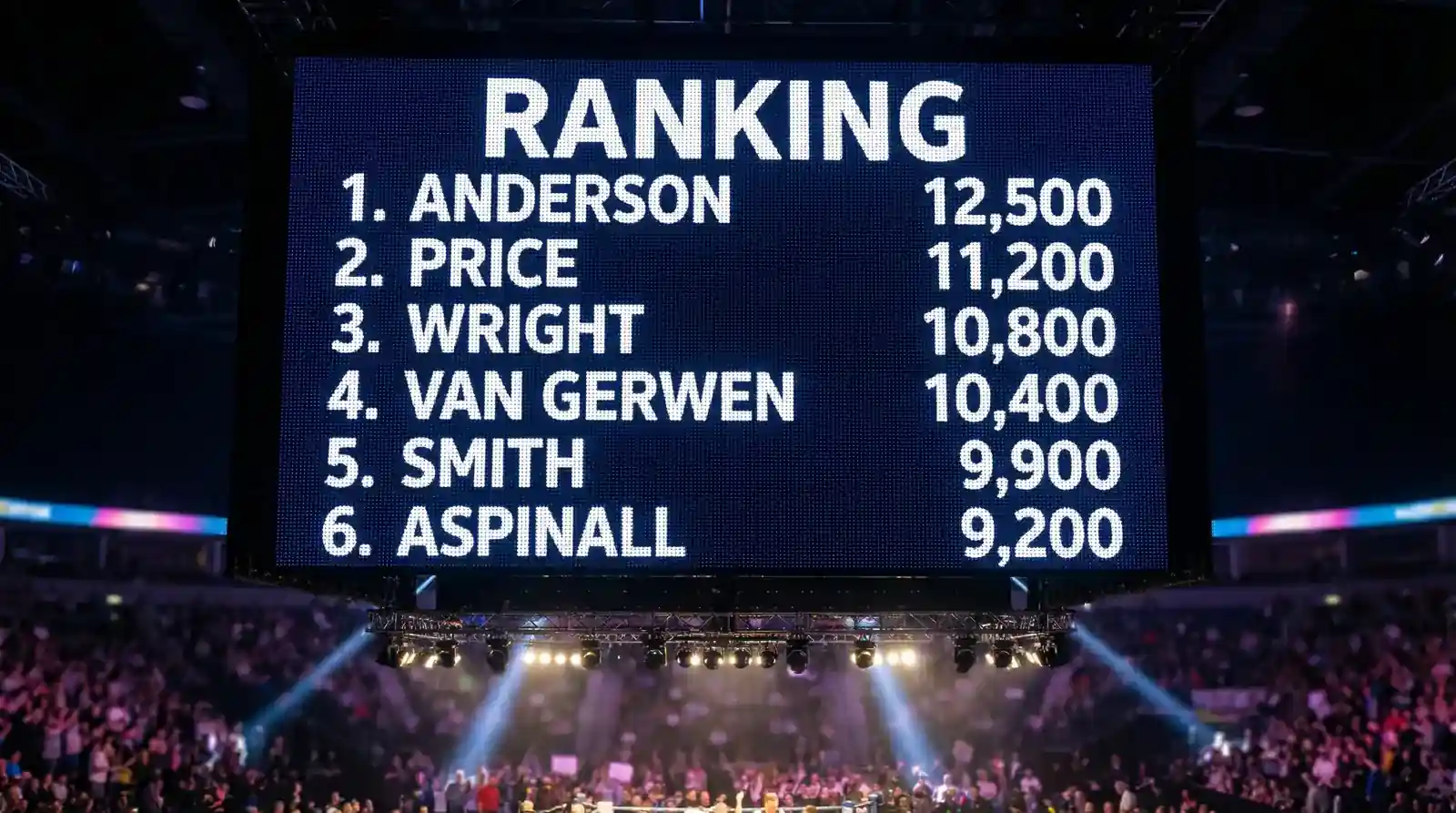
Rankings Drive Seedings — Seedings Drive Odds
Every time a PDC tournament draw is made, the first thing I do is open the Order of Merit and map the seeds against the bracket. The rankings determine who gets seeded where, which determines who plays who in which round, which fundamentally shapes the outright market and every match-by-match price from round one onward. The PDC’s total prize fund exceeded 25 million pounds in 2026, and the distribution of that money — which directly feeds the Order of Merit — decides everything from World Championship seedings to European Tour qualifications.
For bettors, the Order of Merit is both essential reference material and a potential trap. It tells you what the official hierarchy looks like, but it doesn’t tell you whether that hierarchy accurately reflects current ability. Understanding the gap between ranking and reality is one of the quieter edges in darts betting.
How the PDC Order of Merit Is Calculated
The Order of Merit is a prize money ranking calculated over a rolling two-year window. Every pound a player earns on the PDC circuit — from World Championship prize money down to Players Championship last-32 exits — contributes to their ranking total. When a tournament falls off the two-year window, those earnings are removed, and the ranking adjusts accordingly.
Luke Littler’s back-to-back World Championship victories, with the 2026 edition carrying a five-million-pound prize fund and one million to the winner, illustrate how quickly the Order of Merit can shift. Winning the Worlds alone catapults a player near the top of the rankings, and defending the title a year later cements a position that would take years of consistent floor event results to build. Littler’s ranking position is driven disproportionately by two massive results — which means his ranking accurately reflects his ability at the very top of the sport but wouldn’t survive a period of inactivity the way a ranking built on fifty smaller results might.
The rolling two-year window creates a specific dynamic that bettors should understand: a player who had one outstanding season followed by a mediocre one can maintain a high ranking until the outstanding season drops off the window. During that second year, the player’s ranking overstates their current form. Conversely, a rising player who’s performing brilliantly right now might sit lower in the rankings because their older, weaker results are still counting in the two-year total. This lag between current form and ranking position is a consistent source of mispricing in the market.
When Rankings Align With True Ability — and When They Don’t
Rankings align best with current ability at the very top and the very bottom of the spectrum. The top five players on the Order of Merit are almost always genuinely the best five players in the world at that moment, because their prize money accumulation reflects sustained performance across multiple events and formats. Similarly, a player ranked 90th is almost certainly not competitive with the top 32 — the gap in earnings reflects a real gap in ability.
The danger zone is the middle: ranks 10 through 40. In this band, ranking positions can be heavily influenced by one or two strong tournament results that inflate the two-year total without reflecting consistent form. A player who reached one World Championship semi-final but otherwise hovers around the last-32 level at most events might sit at rank 18 on the Order of Merit, which earns them a seed at major events that their week-to-week performance doesn’t justify.
I’ve built a “ranking reliability score” for the top 50 players that compares their Order of Merit position with their average tournament finish over the last six months. When the ranking position and recent average finish diverge by more than ten places, I flag the player as either overranked or underranked. Overranked players tend to be slightly overpriced in match markets because sportsbooks anchor partly on ranking. Underranked players — those performing well recently but sitting lower in the Merit — tend to be underpriced. This discrepancy is one of my more consistent edge sources across a season.
Draw and Seeding Impact on Tournament Odds
Seedings derived from the Order of Merit determine which half and quarter of a tournament draw each player enters. At the 2026 World Championship, with its expanded 128-player field, the top 32 seeds are distributed across the bracket to prevent them meeting before the third round. The placement of seeds shapes the outright market because it determines how many tough matches each player must win to reach the final.
My draw analysis process has three steps. First, I identify the strongest and weakest quarters of the draw based on current form, not ranking. A quarter containing two top-ten seeds is strong, but if one of those seeds has been underperforming for months, the quarter’s actual difficulty is lower than it appears. Second, I map each player’s projected path to the semi-finals and count the number of opponents whose current form is above the threshold I’d consider dangerous. Third, I compare the draw-adjusted path difficulty to the outright price. A player with an easy path priced at the same odds as a player with a brutal path is, all else equal, the better outright bet.
One pattern I’ve noticed across multiple World Championships: the quarter-final pairings produce the most dramatic outright price movements, because that’s where the draw’s difficulty becomes concrete rather than projected. A player who enters the quarter-finals having beaten two underranked but currently sharp opponents is in a different position than one who’s cruised past two genuine qualifiers. By the quarter-final stage, the outright market often overweights the “ease of run” narrative without checking whether the opponents beaten were actually weak at the time of the match. Doing that check yourself — assessing each opponent’s form at the moment of defeat, not their ranking — gives you a more accurate picture of how battle-tested each remaining player actually is.
Does the PDC Order of Merit accurately reflect current player ability?
At the very top and bottom, yes. For ranks 10-40, the two-year rolling window means rankings can lag behind current form by several months. A player who had one outstanding tournament result 18 months ago can maintain a high ranking that no longer reflects their weekly performance. Compare rankings with recent six-month form to identify discrepancies.
How do ranking-based seedings affect outright odds at PDC events?
Seedings determine bracket placement, which shapes each player’s path to the final. A strong seed placed in a weak quarter has an easier run than an equally strong seed in a loaded quarter. Sportsbooks partially account for draw in their outright prices, but they anchor on ranking position rather than current form, creating opportunities for bettors who assess draw difficulty using more recent data.
Learn more about darts betting on our main page.
You may also find PDC World Darts Championship Betting: Format, Odds and Strategic Angles interesting.
Written by the editors at Darts Betting.