Darts Betting Glossary: Every Term You Need to Know
 Available in US
The Language of Darts Betting in One Place
I once overheard a new darts bettor ask a friend what “arrows” meant on a betting forum, and the friend confidently told him it was a type of accumulator. It isn’t. The jargon surrounding darts and darts betting sits at the intersection of two specialised vocabularies — the sport itself and the betting industry — and getting lost in it is easier than most people admit. This glossary covers every term you are likely to encounter, from the oche to the sportsbook, explained in plain language with betting context where it matters.
A-D: Accumulator to Double Out
Accumulator (Acca) — A single bet combining multiple selections. All selections must win for the bet to pay out. In darts, accumulators typically combine match winner picks from different matches in the same session or tournament.
Arrows — Slang for darts, both the physical objects and the sport itself. “Throwing arrows” means playing darts. “Arrows betting” is simply darts betting in informal language.
Bogey Number — A score that leaves an awkward checkout, typically 169 (no three-dart finish exists), or numbers that require difficult combinations. Players and bettors alike avoid situations where a visit leaves a bogey number remaining.
Break of Throw — When the player who did not throw first in a leg wins that leg. Analogous to a break of serve in tennis. A betting market exists around whether breaks will occur and how many per match.
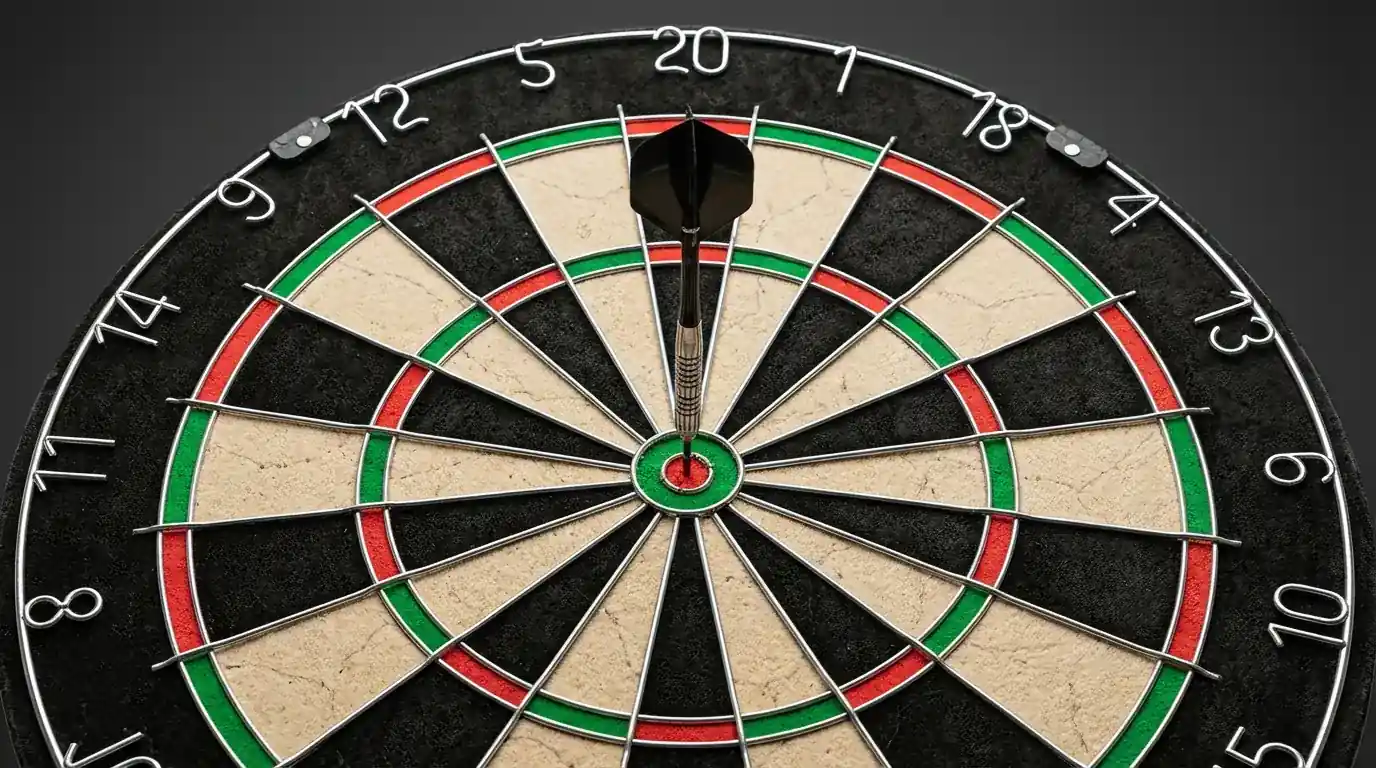
Bull (Bullseye) — The centre of the dartboard. The outer bull scores 25; the inner bull (double bull) scores 50 and counts as a double for finishing. The bull throw before a match determines who throws first.
Checkout — The combination of darts that finishes a leg. A “170 checkout” (treble 20, treble 20, bullseye) is the highest possible finish. Checkout markets let you bet on the highest checkout in a match or whether specific finishes will occur.
Closing Line Value (CLV) — The difference between the odds at which you placed your bet and the closing odds (final price at match start). Consistently beating the closing line is a strong indicator of long-term profitability.
Correct Score — A bet on the exact final scoreline of a match, whether in legs (e.g. 6-4) or sets (e.g. 5-3). Higher odds than match winner because the difficulty of predicting the exact margin is greater.
Double — The narrow outer ring of each number segment, scoring double the segment value. Every standard leg of 501 must finish on a double (including the bullseye). The ability to hit doubles under pressure — checkout percentage — is a critical betting stat.
Double Out — The requirement to finish a leg by hitting a double. This is standard in all professional darts. The PDC’s total prize fund exceeded 25 million pounds in 2026, and every pound is won or lost on the double ring.
E-L: Each-Way to Littler Effect
Each-Way — A bet split into two equal parts: one on the player to win outright and one on them to finish in a specified number of places (e.g. top 2 or top 4). The place portion pays at a fraction of the win odds.
Exchange Betting — Betting on a peer-to-peer platform where you can back (bet for) or lay (bet against) outcomes. Exchanges typically offer tighter margins than traditional sportsbooks because there is no bookmaker margin, just a commission on winning bets.
Expected Value (EV) — The average profit or loss per bet over infinite repetitions. Positive EV means the bet is profitable long-term. Calculated as: (probability of winning x net profit) minus (probability of losing x stake).
Floor Event — A non-televised PDC tournament, typically a Players Championship or Development Tour event. Floor events produce valuable form data because the larger sample of matches reduces the noise present in televised results.
GRAI — Gambling Regulatory Authority of Ireland, established on 5 March 2025 under the Gambling Regulation Act 2024. Ireland’s dedicated gambling regulator with powers to license operators and impose fines up to 20 million euros or 10% of turnover.
Handicap — A bet where one player receives a virtual advantage or disadvantage in legs or sets. A -2.5 leg handicap on a favourite means they must win by three or more legs for the bet to land.
Implied Probability — The probability of an outcome as suggested by the betting odds. Calculated for decimal odds as 1 divided by the odds. Odds of 2.50 imply a 40% probability.
In-Play (Live Betting) — Placing bets during a match while it is in progress. Darts in-play markets adjust after every leg, creating rapid-fire betting windows unique to the sport.
Leg — A single game of 501 within a match. Players start at 501 and reduce their score to zero, finishing on a double. Legs are the basic unit of darts competition and the building block of all match formats.
Littler Effect — The measurable impact of Luke Littler’s emergence on darts viewership, betting volumes, and market dynamics. 35% of the UK population became more interested in darts over two years during his rise — more than 23 million people.
M-R: Matched Betting to Rule Variations
Matched Betting — A technique using sportsbook promotions and exchange lay bets to extract value from free bet offers. Not a traditional betting strategy but a promotional arbitrage method sometimes applied to darts markets.
Maximum (180) — Three darts in the treble 20 bed, scoring the maximum possible 180 points in a single visit. The crowd roar that follows is the sport’s signature sound, and the 180s market lets you bet on how many maximums a match will produce.
Nine-Dart Finish (Nine-Darter) — The perfect leg: scoring 501 in exactly nine darts. Typically two 180s followed by a 141 checkout. Sportsbooks offer markets on whether a nine-darter will occur in a given match or session.
Oche — The line behind which players must stand when throwing. Pronounced “ockey.” The oche is 7 feet 9.25 inches from the face of the dartboard.
Order of Merit — The PDC’s official ranking system, based on prize money earned over a rolling two-year period. Rankings determine seedings and tournament qualification, making them relevant to draw analysis in outright betting.
Outright (Futures) — A bet on who will win an entire tournament rather than an individual match. Outright odds are available weeks or months before a tournament begins, with prices shifting as the event approaches.
Overround — The sportsbook’s built-in margin. If the implied probabilities of all outcomes in a market sum to more than 100%, the excess is the overround. A 4% overround means the sportsbook expects to retain roughly 4% of all stakes wagered on that market.
PDC — Professional Darts Corporation, the governing body of the major darts tour. Organises the World Championship, Premier League, World Matchplay, and all other professional circuit events.
S-Z: Set Play to Watershed
Set — A best-of-five legs mini-match within a larger match. Used primarily at the World Championship. Sets add structural complexity because each set resets to 0-0 in legs, giving underdogs more chances to compete.
Stake — The amount of money risked on a bet. Flat staking means risking the same amount on every bet, typically 1-2% of your total bankroll.
Three-Dart Average — The average score per three-dart visit across a match. The headline performance stat in darts. Elite players average 95-105+, with the very best (notably Littler) regularly exceeding 105 in major matches.
Throw (First Throw) — The advantage of throwing first in a leg. Determined by the bull throw before the match. The first thrower gets first crack at the board each visit, creating a measurable win-rate advantage of approximately 55-62% per leg at PDC level.
Tungsten Tips — Slang for darts betting advice or predictions, playing on the material (tungsten) that professional darts are made from. You might see “tungsten tips” used in forum threads or social media as informal betting recommendations.
Value — A bet where the odds offered are higher than the true probability of the outcome. The foundational concept of profitable sports betting. Finding value requires comparing your assessed probability to the sportsbook’s implied probability.
Wager — Synonym for bet. “Wager on darts” and “bet on darts” are interchangeable in both formal and informal contexts.
Watershed — The GRAI advertising restriction period: gambling ads are banned on Irish TV and radio between 5:30am and 9:00pm. Introduced as part of the regulatory framework under the Gambling Regulation Act 2024 to reduce gambling normalisation, particularly among younger audiences.
Alan Warriner-Little, president of the Professional Darts Players’ Association, has described the current moment in darts as unbelievable — and the vocabulary around the sport and its betting markets has expanded alongside that growth. Keeping this glossary bookmarked will save you time every time you encounter an unfamiliar term. For context on how these terms apply in practice, the complete darts betting guide puts the language to work.
What does ‘arrows’ mean in darts betting slang?
Arrows is informal slang for darts — both the physical throwing implements and the sport itself. ‘Arrows betting’ simply means darts betting. The term originates from the dart’s arrow-like shape and has been used in the sport for decades. You will encounter it frequently on betting forums and in casual discussion.
What is the difference between a leg and a set in darts?
A leg is a single game of 501 where players reduce their score from 501 to zero, finishing on a double. A set is a collection of legs, typically best-of-five, used at certain tournaments like the World Championship. In a sets match, each set resets to 0-0 in legs, adding an extra structural layer that affects betting dynamics.
Find the best options for darts betting.
Read our detailed review of Is Darts Betting Legal in Ireland? GRAI Rules and What Bettors Must Know.
Created by the ”Darts Betting” editorial team.