Darts Betting for Beginners: Your First Steps From Zero to Informed Punter
 Available in US

Darts Is Booming — and Betting on It Has Never Been More Accessible
My first darts bet was a disaster. I backed a player because I’d seen him on television the night before, at odds I didn’t understand, in a market I couldn’t explain if you’d asked. The bet lost, obviously, and I learned nothing from it except that betting randomly is a fast way to lose money. What I wish I’d had was a guide that started from absolute zero — not a guide that assumed I already knew what implied probability meant or how a handicap worked, but one that acknowledged I was starting from scratch.
Darts betting has grown 37% in volume since 2018, driven largely by new bettors entering the market alongside the sport’s soaring popularity. If you’re one of those new arrivals, welcome. This guide is for you — specifically for you, not adapted from a guide written for experienced punters.
Setting Up Your First Betting Account in Ireland
Nearly 46% of the Irish population participates in some form of gambling, and if you’re joining that number through darts betting, the practical setup is straightforward. Choose a sportsbook that’s licensed to operate in Ireland — under the Gambling Regulation Act 2024, the Gambling Regulatory Authority of Ireland (GRAI) oversees operator licensing, so look for evidence of regulatory compliance on any site you consider.
The registration process takes five to ten minutes. You’ll provide your name, address, date of birth, and contact details. You’ll need to verify your identity — this is a legal requirement, not a hassle, and it protects you as much as the operator. Have a form of ID (passport, driving licence) and a proof of address (utility bill, bank statement) ready. Most platforms verify electronically, but some may ask you to upload documents.
Before making your first deposit, set a deposit limit. Every GRAI-licensed operator must offer this feature. Pick a weekly or monthly limit that represents money you can genuinely afford to lose without any impact on your finances. Fifty euros a month is a perfectly reasonable starting point. You can always increase it later if darts betting becomes a sustained hobby, but starting with a limit teaches you discipline from day one.
One practical tip I give every beginner: open accounts at two sportsbooks rather than one. Different operators offer different odds on the same matches, and having two accounts lets you compare prices and take the better one. This habit, called line shopping, is the easiest edge available to any bettor, and it costs nothing.
The Three Markets Every Beginner Should Start With
Darts sportsbooks offer a dizzying array of markets — match winner, correct score, handicap, 180s, checkout specials, outright, in-play — and trying to learn all of them simultaneously is a recipe for confusion and poor decisions. Start with three.
Match winner is the simplest: pick who wins the match. That’s it. No scoreline prediction, no special knowledge of specific statistics, just a binary choice. For your first ten or twenty darts bets, stick exclusively to match winner markets. Learn how the prices feel — what a 1.50 favourite looks like versus a 2.50 underdog, how often each general price range produces a winner, and whether the sportsbook’s pricing aligns with what you observe when watching matches.
Outright tournament winner is the second market worth exploring early. Before a major PDC event, place a small outright bet on a player you’ve researched. It doesn’t matter if it loses — the purpose is to give yourself a stake in the entire tournament, which transforms passive viewing into engaged analysis. You’ll start noticing draw implications, format effects, and form fluctuations because you have skin in the game, and that observational learning accelerates your development as a bettor.
Over/under total 180s is the third beginner-friendly market. It connects directly to the most exciting moment in darts, it’s easy to follow during a match, and it teaches you to think about match dynamics beyond just who wins. Will the combined scoring power of both players produce more or fewer maximums than the line suggests? You’ll start paying attention to scoring styles, match length, and player tempo — all of which feed into more advanced analysis later.
Setting a Starter Bankroll and Staking Sensibly
Your starting bankroll should be an amount you’re comfortable losing entirely. Not theoretically comfortable — actually comfortable. If losing fifty euros would cause you stress, start with twenty. If losing two hundred wouldn’t register, start with two hundred. There is no minimum — the amount doesn’t matter, the principle does.
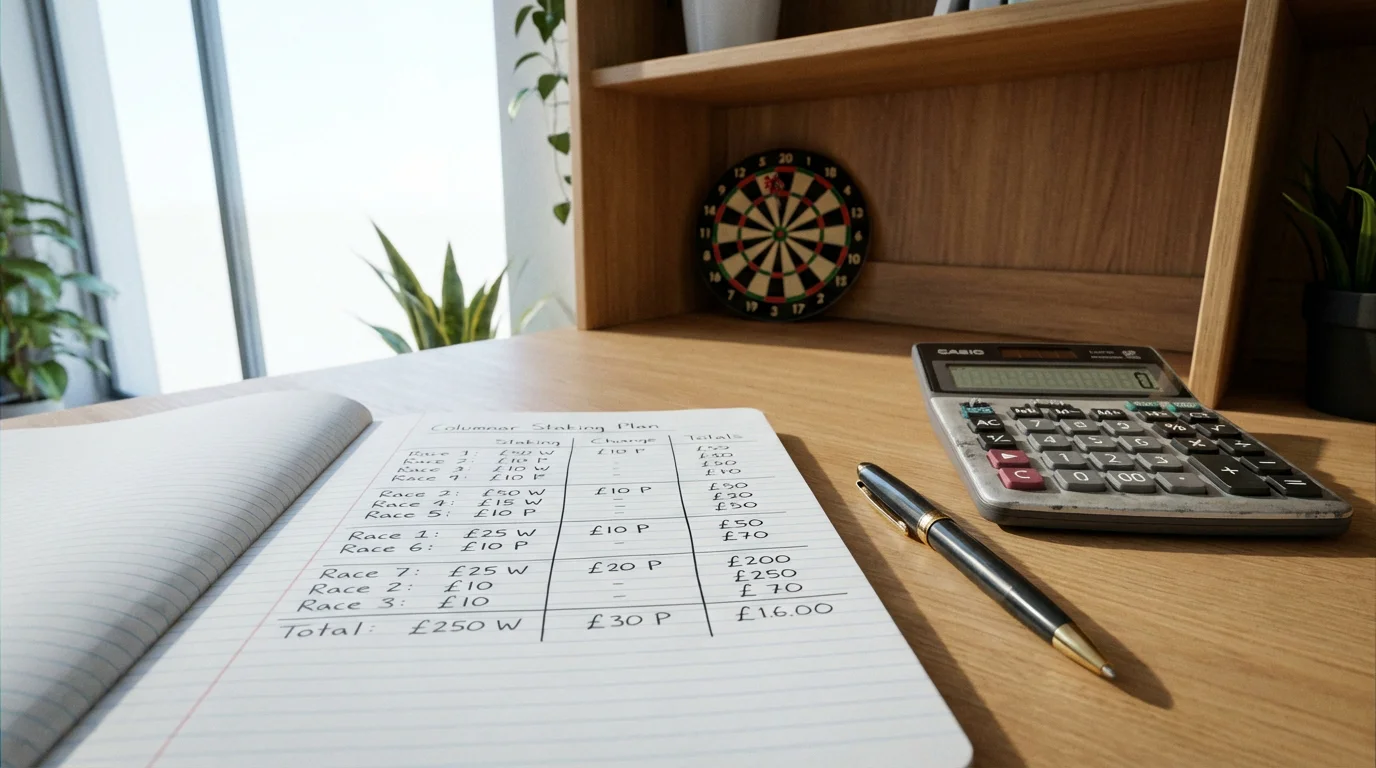
Stake between 1% and 3% of your bankroll per bet. With a hundred-euro bankroll, that’s one to three euros. I know that sounds small, and three-euro bets don’t produce the adrenaline rush of bigger wagers. That’s the point. Your first fifty darts bets are an education, not a profit engine. Small stakes let you learn from mistakes without paying expensive tuition fees.
Keep a record of every bet from day one. A simple spreadsheet with the date, match, market, odds, stake, and result is enough. After your first month, review the record and look for patterns: which markets did you do best in? Where did you make impulsive decisions? Did you follow your staking plan or deviate? This self-review is worth more than any tips column you’ll ever read.
What to Watch and Where to Find Darts Coverage
Betting on darts without watching darts is like reviewing restaurants without eating food. The analytical frameworks and statistical tools I describe across this site are valuable, but they’re built on a foundation of actually watching matches and developing an intuitive understanding of the sport’s rhythms.
Sky Sports is the primary broadcaster for PDC events, covering the World Championship, Premier League, World Matchplay, and other major tournaments. ITV broadcasts selected events including the Masters and UK Open. These packages provide access to the biggest events on the calendar. For floor events and smaller tournaments, the PDC offers online streaming — PDCTV — which covers Players Championship events and other non-televised competitions.
Social media and YouTube channels provide supplementary coverage that’s valuable for beginners. Highlights packages let you watch condensed versions of matches, and analysis channels break down player techniques and match dynamics in ways that accelerate your understanding. The Sky Sports Darts YouTube channel alone generated 8.2 million views during the 2024/25 World Championship — a 78% year-on-year increase that reflects how accessible darts content has become.
Start by watching one televised event per week alongside your betting activity. Within a month, you’ll recognise the top players, understand the formats, and start forming your own opinions about matches — opinions that are worth more than any set of borrowed tips because they’re based on your own observation and developing knowledge. For a comprehensive overview of everything we’ve touched on here, the complete darts betting guide goes deeper on markets, strategy, and the statistical tools that will sharpen your analysis as you progress.
What is the minimum amount I need to start betting on darts?
There is no fixed minimum beyond the sportsbook’s minimum bet amount, which is typically 0.10 to 1.00 euros. A practical starting bankroll of 20-100 euros is enough to learn with, staking 1-3% per bet. The priority is starting with an amount you can afford to lose entirely while you develop your skills and understanding of the markets.
Which PDC events are easiest for beginners to bet on?
Start with the Premier League Darts, which runs weekly with a small field of eight players and a consistent format. The repetition of the same players across the season lets you build familiarity quickly. The World Championship is also good for beginners because of the extensive coverage and the long tournament window that gives you time to observe form trends before placing later-round bets.
Discover everything about darts betting here.
Check out our guide on Darts Betting Glossary: Every Term You Need to Know as well.
Written by the editors at Darts Betting.